Happy Birthday Carl Yastrzemski

Happy birthday to Red Sox great Carl Yastrzemski, who turns 77 today. A leader in virtually every major offensive category in Red Sox history, the man they call Yaz is still one of the franchise’s most popular players.

Revered for playing the lead role in the “1967 Impossible Dream” season, Yaz became baseball’s 14th Triple Crown winner, while leading the Red Sox to the American League Pennant. Powering the Red Sox from last place in 1966, Yaz hit .326 for his second batting title, tied Harmon Killebrew with 44 homers and drove in 121 runs. Yaz capped the season off with 10 hits in 13 at bats.

Upper Deck commemorated the historic feat with the 2007 UD Premier Stitchings “Triple Crown Commemorative Patch”. The card back salutes Yastrzemski’s three AL batting titles, six gold gloves, 18 All-Star Games and his 1989 Hall of Fame enshrinement. Limited to a production run of 50, this popular Yaz item is a great buy for $20.

In one of the greatest seasons ever for a Red Sox player, Yaz led the team to the World Series and bolstered his Triple Crown numbers by pacing the AL in runs, hits and total bases. Over his 23-year-career, Yaz collected 3,419 his, 1,844 RBI, 452 homers — at a time when 400 homers was an accurate benchmark for a top slugger — and seven gold gloves. The 18-time All-Star was inducted into the Baseball Hall of Fame in 1989 on the first ballot.

Yastrzemski’s 1960 Topps rookie card, part of the Sport Magazine “Rookie Star Subset”, sells in the $160- $180 range. Print marks on some copies — a problem throughout the 1960 Topps series — limits the number of truly mint Yaz rookies. The only other major rookie card of the set belongs to Willie McCovey. Finding a well-centered Yaz or McCovey rookie is a daunting task. The popular 1967 Yaz card is a great buy for $18 in excellent condition.

With each passing season the legend of Yastrzemski’s accomplishment grows. Only 15 players have had Triple Crown seasons — Miguel Cabrera joined the select group in 2012 — with Rogers Hornsby and Ted Williams each achieving it twice. Former Red Sox Slugger Jimmie Foxx slugged for the Triple Crown in 1933 while playing for the Philadelphia Athletics.  Baseball immortals such as Hank Aaron and Willie Mays didn’t do it. Babe Ruth came close in 1924, leading the AL in batting and homes, but losing the RBI title to Goose Goslin.

Alex Rodriguez and Barry Bonds have led their respective leagues in all three categories, but never in the same season. In 2006 David Ortiz was first in the AL in homers and RBI, but hit just .287. With more and more batters specializing in either hitting for batting average or power, a Triple Crown winner in the near future is becoming less and less likely.

Red Sox Retire Wade Boggs’ No. 26

Wade Boggs is getting his due. Sixteen years after retiring from baseball, Boggs will have his number 26 placed on the Fenway Park right field facade, alongside the numbers of eight other Red Sox greats and baseball legend Jackie Robinson. The delay likely had something to do with Wade Boggs jumping ship and winning aWorld Series with the Yankees.

The Hall of Fame third baseman was one of the best hitters to ever wear a Red Sox uniform. His .338 Red Sox batting average is second to only Ted Williams. He won five batting titles and six Silver Slugger awards to go along with seven consecutive seasons with 200 or more hits during his 11 years with the Red Sox. His great eye at the plate combined with high batting averages produced remarkable peak seasons. From 1983-1989, Boggs hit .352 with a .446 on-base percentage, leading the AL in OBP in six of those seven years.

A model of consistency at the plate, Boggs produced a slashline of .328/.415/.413 with 3,010 hits in 18 big league seasons. A poor fielder his rookie season, Boggs worked to become one of the game’s better fielding third basemen, earning two Gold Glove Awards. Boggs also made 12 All-Star Game appearances.

Boggs is a key player in the popular 1983 Topps Baseball Card Set. Considered by many collectors to be the top series of the ‘80s, the ‘83 Topps set includes rookie cards of Boggs, Tony Gwynn and Ryne Sandberg as well as the second-year card of . The dual-photo format — an action or posed photo behind a small circular head shot in the lower righthand corner — has been a fan favorite over the years. Borrowed from the 1963 Topps series, the format allowed Topps to feature a wide-array of action photos without neglecting the traditional head shot.

Midway through the 1982 season, Boggs took over third base from reigning AL batting champion Carney Lansford, who landed on the disabled list with an injured ankle. Lansford never regained his job and was eventually traded to the Oakland A’s. Boggs made him expendable by hitting .349 for the season.

After quickly establishing himself as one of baseball’s premier hitters, Boggs — like Gwynn — was somehow excluded from the 1982 Topps Traded Set. Following a brilliant rookie campaign, Boggs was featured prominently in the 1983 Topps, Fleer and Donruss rookie checklists. Boggs’ elite status continued on the field as the second-year rising star lead the AL with a .361 batting average.

Relative newcomers to the world of baseball card collecting in 1983, Fleer and Donruss played second fiddle to Topps in production, marketing and distribution of their baseball card sets. As a result, Boggs’ rather drab-looking Fleer and Donruss rookie cards were not received with the same fanfare as the first-year Topps issue. Decent versions of the Fleer and Donruss rookies are available for $3-$5.

Because Boggs never hit for much power, except for that one season in 1987 — when many observers suspected baseballs had a little extra “bounce” — his rookie cards may have never reached their full potential. Traditionally, the rookie cards of sluggers are more sought after than the rookies of high-average hitters. Gwynn rookie cards may be slightly undervalued for the same reason. Never known for power, Boggs hit 24 homers in 1987 — when home runs were hit at an unprecedented pace — but never collected more than 11 in any other season.

The 1983 Boggs Topps rookie currently sells for $8 in decent condition with highly-graded versions commanding as much as $50. Because of minor production flaws and gum-stained card backs, the highest-graded versions are extremely rare.

Long Lost Reggie Jackson Baseball Card

Remember Reggie Jackson’s only uneventful season from the 1970s, the year he he played for the Baltimore Orioles? A lost season for Jackson, completely ignored by Topps … almost!?! Say what?  First some background information …

On this day 40 years ago (April 2, 1976), Oakland A’s owner Charlie Finley shocked the baseball world by trading Jackson to the Orioles. Knowing he did not have the money re-sign the pending free agent after the season, Finley sent Jackson and left-handed starter Ken Holtzman to the Orioles for outfielder Don Baylor and right-handed pitchers Mike Torrez and Paul Mitchell. Shocked by the transaction and not thrilled with his salary situation, Jackson refused to report to Baltimore until the Orioles increased his salary from $165,000 to $200,000. As a result of the dispute, Jackson missed the first 16 games of the season.

Seeking the limelight, Jackson did not enjoy his brief time in Baltimore. From 1971-1982, Jackson’s teams made the playoffs 10 of 12 times with one of the exceptions being the year he spent wearing an Orioles uniform and batted .277-27-91.

If you’re using your old baseball card sets to chronicle baseball history, you might think that 1976 was a lost season for Jackson; that his time in Baltimore never actually happened. As soon as Jackson signed with the Yankees prior to the 1977 season, Topps quickly airbrushed the original photo, covering the Orioles home uniform and multi-colored hat with Yankee pinstripes and traditional cap. If you look closely, you will see that the colors are rather dull, not the traditional Yankees colors. The card also pictures the green and gold sleeve of a former A’s teammate over Jackson’s shoulder. Jackson’s first official Yankees card (#10) became a key part of the 1977 Topps set and currently sells for $8 in mint condition.

Jackson never “officially” appeared on an Orioles card, however a few original blank-backed proof cards escaped the Topps shredders and found their way into the markRegJacksYanksetplace. Because of its scarcity and Jackson’s October heroics, this proof card has become one of hobby’s most sought-after commodities. The proof card does not have a facsimile autograph commonly featured on ’77 Topps cards.
According to published reports, television commentator,/baseball historian/hobbyist Keith Olbermann owns two versions of this almost singular collectible. One is an actual card, the other is part of an uncut proof sheet that he purchased at a 1989 Topps/Guernsey’s auction for an undisclosed price.

Although Jackson played the 1976 season with the Orioles, he is pictured in an Oakland A’s uniform because Topps did not have time to doctor the photo before the series was released. Later that season, Star Co. finally released a card with Jackson wearing an Orioles uniform. Nearly a decade later Upper Deck released the first memorabilia cards sporting Jackson in an Orioles uniform.

Tim Raines Belongs in the Hall of Fame

Great to see Tim Raines — one of my all-time favorite non-Red Sox players — throw out the first pitch in tonight’s Red Sox – Blue Jays exhibition game in Montreal.

What’s not to like about Tim Raines? He was one of the game’s great leadoff hitters, top base stealers, and — believe it or not — an extra-base-hitting-machine during his 23-year major league career. Lost in the shadow of Rickey Henderson — though I’m not sure why — Raines has yet to garner enough Hall of Fame votes. But digging deeper into the numbers, Raines was every bit the player as Henderson and even rivaled the great Ty Cobb, arguably the best hitter in baseball history.

We all knowRaines Raines was one of the game’s great base stealers, but his consistency on the base paths was unparalleled. The career leader in stolen base percentage (84.7) among players with 400 attempts, Raines is the only player in baseball history to steal at least 70 bases in seven consecutive seasons (1981-1986). He stole 40 consecutive bases between July 1993 – August 1995, a major league record later broken by Ichiro Suzuki with 45 consecutive swipes.

Like Cobb, Raines will never be considered a home run hitter, but the former Montreal Expos outfielder combined extra base hits with stolen bases at an historic rate. He was the only player in baseball history with at least 100, triples, 150 homers and 600 stolen bases. Raines finished his career with 113 triples, 170 homers, and 808 stolen bases.

Need more convincing? Raines was the only player ever with four seasons of 50-plus extra base hits and 70-plus stolen bases. Henderson and Cobb combined for four such seasons; every other HOFer combined for an additional four.

Raines is seldom mentioned with the all-time greats such as Cobb, but the evidence is in the numbers: Raines is the only player in MLB history with five consecutive seasons with at least 30 doubles and 70 stolen bases, which he did in five consecutive seasons from 1982-1986. Before 1982, the last player to record 30 doubles and 70 stolen bases in a season was Cobb in 1915.

For more head-spinning stats, be sure to check out the Ace of MLB Stats Twitter account. Its creator, Ryan Spaeder, seems to be on a personal crusade to get Raines into the Hall of Fame. Raines did the work and Spaeder has aligned the numbers in convincing fashion.

Just under 70 percent of the HOF electorate voted for Raines in January. He’s on course to receive the 75 percent of the vote needed for enshrinement next year. Here’s hoping one of baseball’s great injustices is rectified.

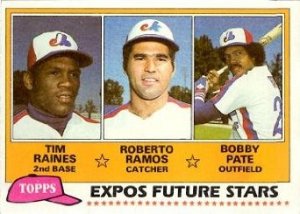
The Raines Topps rookie card is one of the top rookies from the 1981 series. Issued just before the mass-produced sets of the ‘80s, the Expos “Future Prospect” card also includes Roberto Ramos and Bobby Pate, two “future stars” that never panned out. Be careful if you’re buying: The “Future Prospect” cards are notorious for having gum-stained backs.