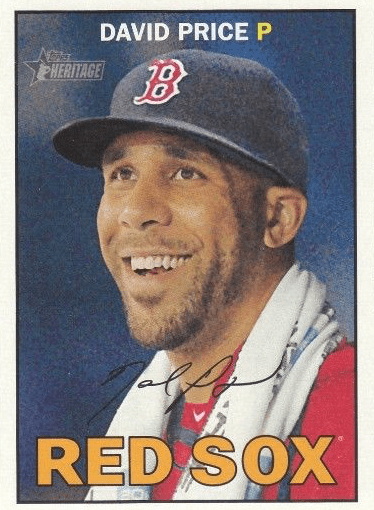
Red Sox Introduce Ace David Price To Rotation

Preaching the need for a true ace to build a contending team, new Red Sox baseball czar Dave Dombrowski responded quickly by signing David Price to a long-term deal during the off season. Price is a genuine, front of the rotation ace — clearly one of the game’s top five pitchers. His resume includes a Cy Young Award and two runner-up finishes to go along with two ERA titles.

The first Price baseball card in a Red Sox uniform is from the 2016 Topps Heritage series, which features the design from the classic 1967 Topps set. The design combines a large player image with a minimal design, making the players the main focus of the set. The design concept made 1967 Topps one of the most popular sets from the ‘60s.

Responding to consecutive last place finishes, the Red Sox get left-handed Price at the peak of his career and durability has never been an issue. He has had only one minor injury in his career, sitting out six weeks in 2013 because of a sore triceps muscle. Price has also been transitioning from a power thrower to a more complete pitcher over the last few seasons. While maintaining a mid-90s fastball, Price has become more reliant on curveballs and changeups, which should limit the wear and tear on his arm.

Price, a standout pitcher at Vanderbilt, first landed on the hobby radar in 2005 when he won two games for the United States National Team while tallying 39 strikeouts in just over 28 games. The following summer, Price led the United States to a gold medal in the World University Baseball Championship held in Cuba. In eight starts for the US, Price was 5-1 with a miniscule 0.20 ERA. Price’s 2005 Topps Team USA card is a popular pre-rookie card readily available for $2. Certified Autographed versions limited to a production run of 475 are selling for $50.

PriceUSA

If there is any knock on Price it’s that his amateur championship success has not translated to playoff success at the major league level. Price is 2-7 — with both wins coming in relief — with a 5.12 ERA in 14 playoff games. At $31 million annually, the man signing the checks and the win-at-all-costs fan base will have much higher expectations over the next seven years.


Given the overall talent in the Red Sox organization, Price will likely have opportunities to improve his postseason record during the length of his contract. The Red Sox are hopeful Price will anchor an unsteady pitching staff, taking pressure off the inconsistent Clay Buchholz, rising star Eduardo Rodriguez and enigmatic veterans Joe Kelly and Rick Porcello.

A true workhorse, Price ranks fourth in the majors in innings and strikeouts, and third in wins since his first full season in 2010. He was arguably the AL’s best starter in 2015, posting an 18-5 record with a 2.45 ERA with 235 strikeouts in 32 starts for the Tigers and Blue Jays last season. Price finished second in 2015 AL Cy Young voting and has placed in the top six four times in his career, including winning it with Tampa Bay in 2012. His 2013 Topps “Chasing Cy Young” game worn jersey card is a nice pickup for $5.

Price, the top overall pick in the 2007 MLB Amateur Draft, has also had tremendous success against stacked AL East lineups of recent years past and is 6-1 with a 1.95 ERA at Fenway Park over his eight-year career. With the best defensive outfield in the league covering his back, Price has positioned himself well for continued success.

Now that Price is standing center stage in a big city baseball market for the first time in his career, expect increased demand in his autograph and game used memorabilia cards. Price’s 2009 Topps Finest “Letter Patch” autograph card (the patch was taken from his actual Vanderbilt baseball uniform) is selling for $325 and is on the rise. His first Red Sox memorabilia and autographed cards will be issued later this spring.

Hank Aaron: The Real Home Run King

On April 8, 1974, Hank Aaron smacked an Al Downing fastball over the leap of Dodgers left fielder Bill Buckner for his 715th home run at Atlanta Stadium, breaking the record held by Babe Ruth for over 50 years. The night of April 8, 1974 still hails as one of the most iconic moments in baseball history. The celebration of Aaron’s accomplishment combined with new-found appreciation for home run hitters from a previous, untainted era has increased interest in Aaron baseball cards.

The 1954 Topps Aaron rookie pictures a raw teenager on the verge of greatness. The card design sports two pictures, a large headshot and a small in-action shot in the lower left-hand corner. Hard to find in mint condition due to wear, dullness, blurry lettering and off-centered photos, near-mint PSA-7 versions sell in the $2,400 range.

Aaron57Topps

The slender 180-lb. outfielder would go on to hit an unblemished 755 home runs over his 23-year career. A right-handed hitter with remarkably powerful wrists and a smoothly crafted swing, Aaron was recognized for home runs, but his legacy included 3,771 hits (third all-time), 2,174 runs (tied for second), 2,297 RBI (first), and a career .305 average. Aaron also displayed outstanding speed and one of the better right-field arms of his time.

Topps, a chewing gum producer new to the trading card business, made a wide array of printing and production gaffes while Aaron was emerging as the game’s top slugger. After just a few years of producing baseball cards, Topps had yet to establish much of a photo library, so pictures were often recycled during the ’50s. The same Aaron head shot was used from 1954-1956.

The 1956 card (#31) also includes an action shot in the lower right-hand corner picturing Willie Mays sliding into home plate wearing a Braves uniform. A Topps artist painted the uniform. The actual photo of Mays appeared in a baseball card publication a year earlier. Near-Mint PSA versions of this hard-to-find relic accidentally picturing two of baseball’s greatest players sells in excess of $2,700.

Topps made an even bigger blunder on Aaron’s card the following year. The production staff accidentally reversed the negative on the 1957 card (#20), which displays baseball’s most prolific right-handed hitter batting left-handed. The card that has no-doubt triggered decades of bar room arguments sells for $100 in excellent condition.

The 1958 Topps “Baseball Thrills” card, picturing Aaron’s classic home run swing, celebrates Aaron’s Game 4 homer that helped propel the Braves over the Yankees to win the 1957 World Series. This Topps set is notorious for being mis-cut and off center. The rare gem is worth up to $125.

The ultra conservative Topps Co. rolled the dice in 1974 by printing “New All-Time Home Run King” on Aaron’s 1974 Topps card (#1) despite Aaron entering the ’74 season one home run shy of tying Ruth’s career mark. Fortunately for Topps, Aaron kept the suspense to a minimum, hitting a homerun on Opening Day. The ’74 Topps card became officially accurate a few days later when Aaron broke the record on a nationally televised Monday Night Baseball game with a homer against the Dodgers.

Aaron has gained popularity with today’s collectors, as baseball card manufacturers continue to combine baseball history with modern day memorabilia cards. His 2014 Topps Tribute “Game-Used Bat” card is a great find for $40.

Long Lost Reggie Jackson Baseball Card

Remember Reggie Jackson’s only uneventful season from the 1970s, the year he he played for the Baltimore Orioles? A lost season for Jackson, completely ignored by Topps … almost!?! Say what?  First some background information …

On this day 40 years ago (April 2, 1976), Oakland A’s owner Charlie Finley shocked the baseball world by trading Jackson to the Orioles. Knowing he did not have the money re-sign the pending free agent after the season, Finley sent Jackson and left-handed starter Ken Holtzman to the Orioles for outfielder Don Baylor and right-handed pitchers Mike Torrez and Paul Mitchell. Shocked by the transaction and not thrilled with his salary situation, Jackson refused to report to Baltimore until the Orioles increased his salary from $165,000 to $200,000. As a result of the dispute, Jackson missed the first 16 games of the season.

Seeking the limelight, Jackson did not enjoy his brief time in Baltimore. From 1971-1982, Jackson’s teams made the playoffs 10 of 12 times with one of the exceptions being the year he spent wearing an Orioles uniform and batted .277-27-91.

If you’re using your old baseball card sets to chronicle baseball history, you might think that 1976 was a lost season for Jackson; that his time in Baltimore never actually happened. As soon as Jackson signed with the Yankees prior to the 1977 season, Topps quickly airbrushed the original photo, covering the Orioles home uniform and multi-colored hat with Yankee pinstripes and traditional cap. If you look closely, you will see that the colors are rather dull, not the traditional Yankees colors. The card also pictures the green and gold sleeve of a former A’s teammate over Jackson’s shoulder. Jackson’s first official Yankees card (#10) became a key part of the 1977 Topps set and currently sells for $8 in mint condition.

Jackson never “officially” appeared on an Orioles card, however a few original blank-backed proof cards escaped the Topps shredders and found their way into the markRegJacksYanksetplace. Because of its scarcity and Jackson’s October heroics, this proof card has become one of hobby’s most sought-after commodities. The proof card does not have a facsimile autograph commonly featured on ’77 Topps cards.

According to published reports, television commentator,/baseball historian/hobbyist Keith Olbermann owns two versions of this almost singular collectible. One is an actual card, the other is part of an uncut proof sheet that he purchased at a 1989 Topps/Guernsey’s auction for an undisclosed price.

Although Jackson played the 1976 season with the Orioles, he is pictured in an Oakland A’s uniform because Topps did not have time to doctor the photo before the series was released. Later that season, Star Co. finally released a card with Jackson wearing an Orioles uniform. Nearly a decade later Upper Deck released the first memorabilia cards sporting Jackson in an Orioles uniform.

Topps 2016 Baseball Makeover Is A Hit

The long overdue Topps Baseball makeover has finally happened. The 2016 base version features an almost-full-bleed photo — a distinct and much-needed difference from the white borders that became a pillar in recent Topps releases. The new look is similar to the popular Topps Stadium Club and Fleer UltrTrout 2016a sets of the early to mid 1990s. A faint smokey effect on opposite corners of the base cards seems to enhance the photo and adds to the modern design. Additionally, a diagonal team logo is placed in the corner alongside a small text box at the bottom.

Although change does not come easy for extreme traditionalists — a large segment of the baseball card collecting hobby — Topps deemed the change necessary moving forward. In a press announcement, Topps senior art director John Doldan stated, “We have had a white border for so many years and it was sort of a staple of the Topps design. I think we are trying to move forward and make the cards a little more modern and current. I think gradually we have been going in that direction and break from the past a little bit.”

The 2016 Topps Series One base 350-card base set feature rookies, veterans, future stars, World Series highlights, league leaders and team cards. Mike Trout was voted by fans and collectors to be card #1. One of the more colorful cards captures the infamous Jose Bautista playoff bat flip.

Bautista 2016 ToppsThe series also pays homage to late Topps patriarch Sy Berger and the history of Wrigley Field with special subsets. The 65-card “Berger’s Best” subset features an iconic card reproduced from each year since 1952. The “100 Years of Wrigley Field” features 25 of the most memorable Chicago Cubs moments.

The rookie checklist features:

  • Hector Olivera, Atlanta Braves
  • Henry Owens, Boston Red Sox
  • Kyle Schwarber, Chicago Cubs
  • Corey Seager, Los Angels Dodgers
  • Miguel Sano, Minnesota Twins
  • Michael Conforto, New York Mets
  • Greg Bird, New York Yankees
  • Luis Servino, New Yankees
  • Aaron Nola, Philadelphia
  • Stephen Piscotty, St. Louis Cardinals
  • Trea Turner, Washington Nationals

The new look combined with unique subsets and a decent rookie checklist makes 2016 Topps a winner. Looking forward to Series 2 in June.