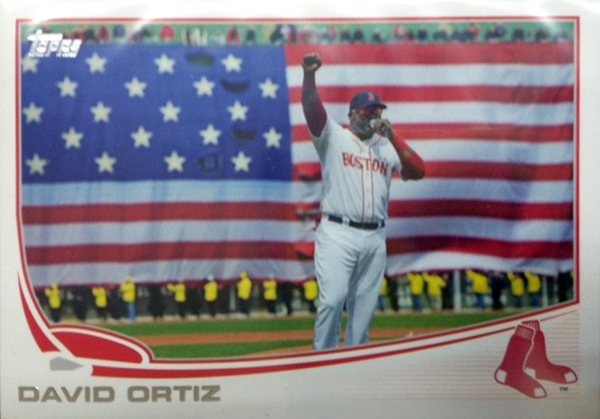
David Ortiz 2013 Topps Boston Strong Variation

Since joining the Red Sox 13 years ago, David Ortiz has become the face of the franchise, leading the team to three World Series championships while becoming just the 27th member of baseball’s exclusive 500 home run club. On the verge of retirement, Ortiz has become increasingly popular among baseball card collectors. A wide-range of Ortiz variation, rookie, game-used-memorabilia, and autographed baseball cards have been heating up the hobby since the start of the 2016 season, but for the people of Boston there is one card that stands out from the  others.

Some of the most memorable and coveted baseball cards are the ones that capture a unique moment in baseball or a city’s history. The extremely limited variation of Ortiz’s 2013 second series Topps card captures one of the more emotional moments in the Boston sports history.  A defiant Ortiz took the field just five days after the tragic Boston Marathon bombing, making an impassioned, heartfelt speech declaring the city’s resolve.

Known in collectible circles as the “Boston Strong” card, Ortiz is pictured with a microphone in one hand and a clenched fist raised to the heavens with the other in front of giant American flag draped over Fenway’s left field wall, creating a uniquely patriotic background. Upon release, the short-printed “Boston Strong” card sold in the $50-$75 range. Following the Red Sox third World Series title in 10 years later that season, the card was selling in excess of $150. With the Big Papi Farewell Tour in full swing, the card is currently selling for as much as $200.

Ortiz played a huge role in the Red Sox six-game 2013 World Series victory over the St. Louis Cardinals, hitting .688 with two homers and six RBI en route to being named World Series MVP. The popular Topps World Champion autograph insert set features top postseason sluggers. The 2014 edition captures Ortiz’s famed home run stroke along with his certified signature. Limited to a production run of 50, the Ortiz autographed card sells for $59.

Red Sox Retire Wade Boggs’ No. 26

Wade Boggs is getting his due. Sixteen years after retiring from baseball, Boggs will have his number 26 placed on the Fenway Park right field facade, alongside the numbers of eight other Red Sox greats and baseball legend Jackie Robinson. The delay likely had something to do with Wade Boggs jumping ship and winning aWorld Series with the Yankees.

The Hall of Fame third baseman was one of the best hitters to ever wear a Red Sox uniform. His .338 Red Sox batting average is second to only Ted Williams. He won five batting titles and six Silver Slugger awards to go along with seven consecutive seasons with 200 or more hits during his 11 years with the Red Sox. His great eye at the plate combined with high batting averages produced remarkable peak seasons. From 1983-1989, Boggs hit .352 with a .446 on-base percentage, leading the AL in OBP in six of those seven years.

A model of consistency at the plate, Boggs produced a slashline of .328/.415/.413 with 3,010 hits in 18 big league seasons. A poor fielder his rookie season, Boggs worked to become one of the game’s better fielding third basemen, earning two Gold Glove Awards. Boggs also made 12 All-Star Game appearances.

Boggs is a key player in the popular 1983 Topps Baseball Card Set. Considered by many collectors to be the top series of the ‘80s, the ‘83 Topps set includes rookie cards of Boggs, Tony Gwynn and Ryne Sandberg as well as the second-year card of . The dual-photo format — an action or posed photo behind a small circular head shot in the lower righthand corner — has been a fan favorite over the years. Borrowed from the 1963 Topps series, the format allowed Topps to feature a wide-array of action photos without neglecting the traditional head shot.

Midway through the 1982 season, Boggs took over third base from reigning AL batting champion Carney Lansford, who landed on the disabled list with an injured ankle. Lansford never regained his job and was eventually traded to the Oakland A’s. Boggs made him expendable by hitting .349 for the season.

After quickly establishing himself as one of baseball’s premier hitters, Boggs — like Gwynn — was somehow excluded from the 1982 Topps Traded Set. Following a brilliant rookie campaign, Boggs was featured prominently in the 1983 Topps, Fleer and Donruss rookie checklists. Boggs’ elite status continued on the field as the second-year rising star lead the AL with a .361 batting average.

Relative newcomers to the world of baseball card collecting in 1983, Fleer and Donruss played second fiddle to Topps in production, marketing and distribution of their baseball card sets. As a result, Boggs’ rather drab-looking Fleer and Donruss rookie cards were not received with the same fanfare as the first-year Topps issue. Decent versions of the Fleer and Donruss rookies are available for $3-$5.

Because Boggs never hit for much power, except for that one season in 1987 — when many observers suspected baseballs had a little extra “bounce” — his rookie cards may have never reached their full potential. Traditionally, the rookie cards of sluggers are more sought after than the rookies of high-average hitters. Gwynn rookie cards may be slightly undervalued for the same reason. Never known for power, Boggs hit 24 homers in 1987 — when home runs were hit at an unprecedented pace — but never collected more than 11 in any other season.

The 1983 Boggs Topps rookie currently sells for $8 in decent condition with highly-graded versions commanding as much as $50. Because of minor production flaws and gum-stained card backs, the highest-graded versions are extremely rare.

Varitek & Wakefield Inducted Into Red Sox Hall of Fame

Jason Varitek and Tim Wakefield, two of the most popular players in Red Sox history, were rightfully inducted into the Red Sox Hall of Fame last night. The two Red Sox icons announced their retirement and simultaneously tossed out the ceremonial first pitches in the home opener four years ago.

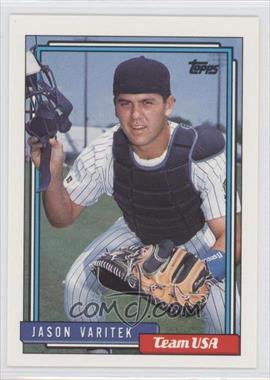
Although Red Sox fans were well aware of Varitek’s significance since his 1998 debut, his rookie baseball card — the 1992 Topps Traded (#123T) — did not receive national acclaim until the Captain’s infamous tussle with Alex Rodriguez that sparked the team’s World Series drive. At the time, this true rookie card sporting the former Georgia Tech star in his Olympic Baseball uniform was selling for $15. Today the same card is a great addition to any Red Sox collection for $5.

On July 31, 1997, the foundation for the the 2004 and 2007 Red Sox World Series teams was put in place. That was the day the Red Sox GM Dan Duquette flee
ced the Seattle Mariners, Heathcliff Slocumb for Varitek and pitching prospect Derek Lowe. Managers, coaches and teammates all confirm that Varitek set the tone for those championship teams.

A catcher with questionable skills in the minor leagues, Varitek became an expert handler of pitchers over his 15-year-career with the Red Sox. He quickly became a fan favorite for his determination and unselfish commitment to winning. As much as anyone, Varitek was responsible for the Red Sox World Series drought ending at 86 years.

So where does Jason Varitek stand in Red Sox history? He caught a major league record four no-hitters, steering Hideo Nomo (2001), Lowe (2002), Clay Buchholz (2007), and Jon Lester (2008) into history. He is the only player in history to have played in the Little League World Series, College World Series, Olympics, Major League World Series and the World Baseball Classic.

The 2007 Upper Deck Goudey “Big League” throwback card (#54) captures one of Varitek’s many unique accomplishments. The card back highlights Varitek becoming the fourth consecutive Red Sox player to hit a home run in an April 2007 game against the Yankees as the Red Sox became just the fifth major league team to smack four straight homers.

The Red Sox Captain has two World Series rings, hit 11 home runs in 63 career postseason games and made three All-Star appearances. His career does not scream Hall of Fame, but he was one of the most significant players to ever wear a Red Sox uniform.

Wakefield also made his mark in Red Sox history. The knuckleballer had 200 career victories, including 186 with the Red Sox, just six shy of the team record shared by Cy Young and Roger Clemens. Wake’s 17 years of service with the Sox is exceeded only by Carl Yastrzemski, Ted Williams and Dwight Evans. He’s featured prominently on the team’s all-time list: first in appearances (590), starts (430) and innings pitched (3,006); second in strikeouts (2,046).

Not bad for a minor league first baseman turned knuckleballer claimed off the scrap heap nearly two decades ago. Wakefield’s limited 1988 Watertown Pirates minor league card is a great buy for $10.

Jackie Bradley Jr. Bursts Onto The Scene

There’s a reason why the Red Sox — fresh off their third World Series Championship in 10 years — allowed Jacoby Ellsbury to flee to New York following the the 2013 season with little resistance.

The reason was Jackie Bradley Jr. The same reason why Cuban import Rusney Castillo, who signed a $72.5 million contract in 2014, is trying to find his groove with the AAA Pawtucket Red Sox.

There is a reason why former Red Sox general manager Ben Cherington and newly appointed baseball chief Dave Dombrowski rebuked the many trade offers for the multi-talented Bradley over the past three years despite Bradley’s anemic .198 batting average and .531 OPS in his 2014 major league debut season. That reason is coming to fruition on a nightly basis.

The previously all-field, no-hit center fielder has become one of baseball’s most dangerous offensive threats. Bradley is working on a 15-game hitting streak, the longest in the majors this season. During that time, he is hitting a robust .382 with four doubles, three triples, four homers and 17 RBI with a sizzling 1.215 OPS. Bradley’s .903 OPS for the season is 13th in the AL, just behind proven offensive forces Mike Trout (.964) and Josh Donaldson (.931).

Although the sample size is small, Bradley has been one of baseball’s toughest outs this season. Facing defenses stacked to the right side, Bradley has found the gaps with a powerful opposite-field swing. He has also been able to pull the ball with authority when facing pitches on the inner half of the plate.

With just parts of three major league seasons under his belt, Bradley already has a wide-array of baseball cards ranging no-glitz minor league cards to chrome and high-premium rookies. His earliest cards date back to his college days.

As the driving force behind the University of South Carolina’s first national championship in 2010, Bradley established himself as a highly-skilled offensive and defensive player worthy of first-round consideration in the MLB amateur draft. Bradley hit .368, with a mind-blowing 1.060 OPS, 60 RBI, 56 runs, 13 homers and seven steals in 67 games during the regular season. Ten hits during the World Series earned the Richmond, VA native the College World Series Most Outstanding Player Award. Bradley’s 2010 Topps “Collegiate Team” Triple Jersey is a great buy for $5.

Later tJBJRChat summer, Bradley threw out the first pitch at a Kansas City Royals game as Major League Baseball honored the South Carolina Gamecocks championship team. The recognition continued as Bradley was named to the Team USA Collegiate National Team.

The 2010 Bowman Platinum Rookie, Bradley’s first baseball card of note, captures the five-tool outfielder in his left-handed stance against a silhouetted baseball field background. This card is a great buy for $3 with the “Gold” parallel version selling for $8. High-gloss Bowman Platinum rookie cards gain significant value as rising stars develop. Trout, Bryce Harper, Mike Stanton, Buster Posey and Jason Heyward Platinum rookies are some of the hobby’s most sought-after cards.

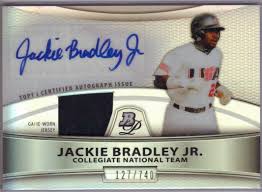
Bradley’s first memorabilia card can also be found in the Platinum Series. His USA Autograph/Jersey card with a production run of 740 sell for $45 and are on the rise. The more scarce version, limited to a production run of 50, is approaching $100 in value. Be sure to keep the Platinum cards in protective shields, as fingerprints will appear on the silver or gold foil and edges chip with the slightest contact.

A subpar junior season, which ended with a wrist injury, turned into good fortune for the Red Sox. Watching a player with off-the-chart tools and advanced skills slip through the first round, the Red Sox pounced on Bradley with the 40th overall pick. He was actually their fourth pick of the day, behind highly-touted pitcher Matt Barnes, catcher Blake Swihart and pitcher Henry Owens. Bradley quickly proved his worth by reaching AA-ball in his first full season and finishing second in the system in batting average and first in on-base percentage.

Bradley’s 2012 Bowman Rookie — his first card in a Red Sox uniform — is a great buy for $1, while the chrome version is selling for $2.00. Still reasonably priced, now is the time to buy these cards. Chrome Refractor Autograph versions are selling for as much as $90.

Red Sox Introduce Ace David Price To Rotation

Preaching the need for a true ace to build a contending team, new Red Sox baseball czar Dave Dombrowski responded quickly by signing David Price to a long-term deal during the off season. Price is a genuine, front of the rotation ace — clearly one of the game’s top five pitchers. His resume includes a Cy Young Award and two runner-up finishes to go along with two ERA titles.

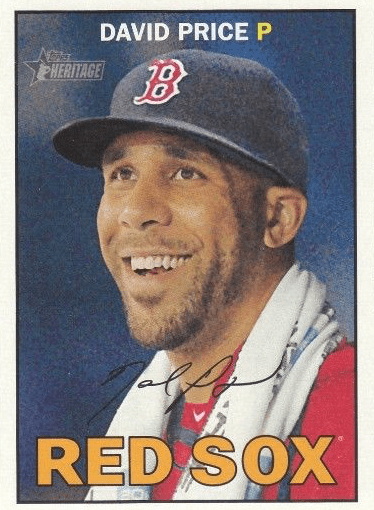
The first Price baseball card in a Red Sox uniform is from the 2016 Topps Heritage series, which features the design from the classic 1967 Topps set. The design combines a large player image with a minimal design, making the players the main focus of the set. The design concept made 1967 Topps one of the most popular sets from the ‘60s.

Responding to consecutive last place finishes, the Red Sox get left-handed Price at the peak of his career and durability has never been an issue. He has had only one minor injury in his career, sitting out six weeks in 2013 because of a sore triceps muscle. Price has also been transitioning from a power thrower to a more complete pitcher over the last few seasons. While maintaining a mid-90s fastball, Price has become more reliant on curveballs and changeups, which should limit the wear and tear on his arm.

Price, a standout pitcher at Vanderbilt, first landed on the hobby radar in 2005 when he won two games for the United States National Team while tallying 39 strikeouts in just over 28 games. The following summer, Price led the United States to a gold medal in the World University Baseball Championship held in Cuba. In eight starts for the US, Price was 5-1 with a miniscule 0.20 ERA. Price’s 2005 Topps Team USA card is a popular pre-rookie card readily available for $2. Certified Autographed versions limited to a production run of 475 are selling for $50.

PriceUSA

If there is any knock on Price it’s that his amateur championship success has not translated to playoff success at the major league level. Price is 2-7 — with both wins coming in relief — with a 5.12 ERA in 14 playoff games. At $31 million annually, the man signing the checks and the win-at-all-costs fan base will have much higher expectations over the next seven years.


Given the overall talent in the Red Sox organization, Price will likely have opportunities to improve his postseason record during the length of his contract. The Red Sox are hopeful Price will anchor an unsteady pitching staff, taking pressure off the inconsistent Clay Buchholz, rising star Eduardo Rodriguez and enigmatic veterans Joe Kelly and Rick Porcello.

A true workhorse, Price ranks fourth in the majors in innings and strikeouts, and third in wins since his first full season in 2010. He was arguably the AL’s best starter in 2015, posting an 18-5 record with a 2.45 ERA with 235 strikeouts in 32 starts for the Tigers and Blue Jays last season. Price finished second in 2015 AL Cy Young voting and has placed in the top six four times in his career, including winning it with Tampa Bay in 2012. His 2013 Topps “Chasing Cy Young” game worn jersey card is a nice pickup for $5.

Price, the top overall pick in the 2007 MLB Amateur Draft, has also had tremendous success against stacked AL East lineups of recent years past and is 6-1 with a 1.95 ERA at Fenway Park over his eight-year career. With the best defensive outfield in the league covering his back, Price has positioned himself well for continued success.

Now that Price is standing center stage in a big city baseball market for the first time in his career, expect increased demand in his autograph and game used memorabilia cards. Price’s 2009 Topps Finest “Letter Patch” autograph card (the patch was taken from his actual Vanderbilt baseball uniform) is selling for $325 and is on the rise. His first Red Sox memorabilia and autographed cards will be issued later this spring.

Hank Aaron: The Real Home Run King

On April 8, 1974, Hank Aaron smacked an Al Downing fastball over the leap of Dodgers left fielder Bill Buckner for his 715th home run at Atlanta Stadium, breaking the record held by Babe Ruth for over 50 years. The night of April 8, 1974 still hails as one of the most iconic moments in baseball history. The celebration of Aaron’s accomplishment combined with new-found appreciation for home run hitters from a previous, untainted era has increased interest in Aaron baseball cards.

The 1954 Topps Aaron rookie pictures a raw teenager on the verge of greatness. The card design sports two pictures, a large headshot and a small in-action shot in the lower left-hand corner. Hard to find in mint condition due to wear, dullness, blurry lettering and off-centered photos, near-mint PSA-7 versions sell in the $2,400 range.

Aaron57Topps

The slender 180-lb. outfielder would go on to hit an unblemished 755 home runs over his 23-year career. A right-handed hitter with remarkably powerful wrists and a smoothly crafted swing, Aaron was recognized for home runs, but his legacy included 3,771 hits (third all-time), 2,174 runs (tied for second), 2,297 RBI (first), and a career .305 average. Aaron also displayed outstanding speed and one of the better right-field arms of his time.

Topps, a chewing gum producer new to the trading card business, made a wide array of printing and production gaffes while Aaron was emerging as the game’s top slugger. After just a few years of producing baseball cards, Topps had yet to establish much of a photo library, so pictures were often recycled during the ’50s. The same Aaron head shot was used from 1954-1956.

The 1956 card (#31) also includes an action shot in the lower right-hand corner picturing Willie Mays sliding into home plate wearing a Braves uniform. A Topps artist painted the uniform. The actual photo of Mays appeared in a baseball card publication a year earlier. Near-Mint PSA versions of this hard-to-find relic accidentally picturing two of baseball’s greatest players sells in excess of $2,700.

Topps made an even bigger blunder on Aaron’s card the following year. The production staff accidentally reversed the negative on the 1957 card (#20), which displays baseball’s most prolific right-handed hitter batting left-handed. The card that has no-doubt triggered decades of bar room arguments sells for $100 in excellent condition.

The 1958 Topps “Baseball Thrills” card, picturing Aaron’s classic home run swing, celebrates Aaron’s Game 4 homer that helped propel the Braves over the Yankees to win the 1957 World Series. This Topps set is notorious for being mis-cut and off center. The rare gem is worth up to $125.

The ultra conservative Topps Co. rolled the dice in 1974 by printing “New All-Time Home Run King” on Aaron’s 1974 Topps card (#1) despite Aaron entering the ’74 season one home run shy of tying Ruth’s career mark. Fortunately for Topps, Aaron kept the suspense to a minimum, hitting a homerun on Opening Day. The ’74 Topps card became officially accurate a few days later when Aaron broke the record on a nationally televised Monday Night Baseball game with a homer against the Dodgers.

Aaron has gained popularity with today’s collectors, as baseball card manufacturers continue to combine baseball history with modern day memorabilia cards. His 2014 Topps Tribute “Game-Used Bat” card is a great find for $40.

What To Expect From The Red Sox Lineup in 2016

Around the horn with the Red Sox lineup …

DAVID ORTIZ
Ortiz Ortiz is the only major leaguer to slug 30 homers and 100 RBI in each of the last three seasons. The Red Sox need the same  production from their 40-year-old DH during the Big Papi Farewell Tour. The spotlight usually brings the best out of Ortiz, which is good news for the Red Sox. Ortiz rookie and memorabilia cards will be hot commodities by season’s end.

HANLEY RAMIREZ

By all accounts, Ramirez’s transition to first base has been far from flawless, but much better than expected. I still have reservations. Ramirez has frustrated coaching staffs with overall indifference throughout his career. Entering his 13th big league season, should we expect a change in attitude? Ramirez has displayed the ability to field ground balls and handle cut-offs. He struggles with scooping balls thrown in the dirt. I’m having trouble picturing the less-than-nibble Ramirez starting and finishing a 3-6-3 double play. Much of the Red Sox success — or lack of success — will depend on Ramirez’s ability to be an offensive force while learning a new position — a position where there is little room for error.

DUSTIN PEDROIA

When Pedroia is healthy, he’s one of the game’s best all-around second baseman and a lynchpin at the top of the Red Sox batting order. He’s at the point of his career where he may have to sit once a week or so. Keeping Pedroia strong and playing at a high level is one of the main goals of the coaching staff this season.

XANDER BOGAERTS
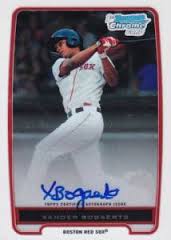
xanderHe’s becoming one of the game’s top shortstops right before our very eyes. Hard work has brought out his natural offensive and defensive abilities. Look for a little less batting average and a little more power and production in 2016. Buy his baseball cards early and often while they are still affordable.

TRAVIS SHAW

A former first baseman, Shaw has quickly become the best third baseman on the team — not by default, but from tremendous overall play at the end of last season and to this point in spring training. A left-handed hitter with the ability to drive the ball to all fields, the Red Sox are intrigued by Shaw’s Fenway power potential. At this point, Shaw is an absolute must everyday player. Taking a look at Shaw’s early baseball cards isn’t a bad idea.

PABLO SANDOVAL

A complete bust. The weight issues, anemic hitting and lack of range are well documented. Quite simply, Sandoval was MLB’s Least Valuable Player last season. With little defensive ability these days and no proven record as a pinch hitter, the former World Series MVP is not expected to make much of an impact this season. With $75 million still owed to him, Sandoval appears to be untradeable — unless the Red Sox eat a ton of money. Bad situation not matter how you look at it.

MOOKIE BETTS
BettsHe’s young, dynamic, extremely talented, articulate, good natured, and committed to excellence — reminiscent of Andrew McCutchen. Enjoy the ride folks, you don’t see this type of player very often. I’m looking for deals on his baseball cards as well.

JACKIE BRADLEY, Jr.

A bit of an enigma early in his career, Bradley needs to prove he’s more than an all-field, no-hit player. Defensively, Bradley is in a class by himself, combining speed, athleticism and an uncanny ability read the ball off the bat. Offensively he’s displayed stretches of power and production along with on base potential. There have also been miserable stretches of non-stop swinging and missing. Will the real Jackie Bradley Jr. please stand up.

BROCK HOLT

The jack-of-all-trades player will get most of his at bats in left field to start the season. The Brock Star won’t put up huge numbers, but he’s a smart, steady, grinding type of player with lots of energy. One of the more valuable players on the team, Holt will also serve as backup for all infield positions. Just call him Ben Zobrist-lite.

CHRIS YOUNG

Mashes left handed pitching, should be a good fit at Fenway. Platooning with Holt leaves the Red Sox left field is in good hands.

RUSNEY CASTILLO

Castillo has a huge contract and lots of potential, but is fifth on the Red Sox outfield depth chart — not a good place to be considering all of the talent above him. A plus fielder and fast runner, Castillo has yet to prove he can consistently hit major league fastballs. Most of the competition in Cuba threw an assortment of junk, which Castillo mashed. He’s finding the power pitching of the majors much more challenging. Wouldn’t call Castillo a bust just yet, but the Red Sox may have overestimated his talent.

BLAKE SWIHART / RYAN HANIGAN / CHRISTAIN VAZQUEZ

Swihart gets the nod to start the season. The Red Sox expect big things offensively from 24-year-old switch-hitter and continued improvement defensively. Vazquez is a defensive specialist adept at calling games and framing pitches. The Red Sox will bring him along slowly, hoping to restore his cannon arm a year removed from Tommy John surgery. At some point, the Red Sox will need to decide between the Swihart’s offensive production and Vazquez’s defense and leadership. Not a bad problem to have. In the meantime, Hanigan is a sound backup.
Long Lost Reggie Jackson Baseball Card

Remember Reggie Jackson’s only uneventful season from the 1970s, the year he he played for the Baltimore Orioles? A lost season for Jackson, completely ignored by Topps … almost!?! Say what?  First some background information …

On this day 40 years ago (April 2, 1976), Oakland A’s owner Charlie Finley shocked the baseball world by trading Jackson to the Orioles. Knowing he did not have the money re-sign the pending free agent after the season, Finley sent Jackson and left-handed starter Ken Holtzman to the Orioles for outfielder Don Baylor and right-handed pitchers Mike Torrez and Paul Mitchell. Shocked by the transaction and not thrilled with his salary situation, Jackson refused to report to Baltimore until the Orioles increased his salary from $165,000 to $200,000. As a result of the dispute, Jackson missed the first 16 games of the season.

Seeking the limelight, Jackson did not enjoy his brief time in Baltimore. From 1971-1982, Jackson’s teams made the playoffs 10 of 12 times with one of the exceptions being the year he spent wearing an Orioles uniform and batted .277-27-91.

If you’re using your old baseball card sets to chronicle baseball history, you might think that 1976 was a lost season for Jackson; that his time in Baltimore never actually happened. As soon as Jackson signed with the Yankees prior to the 1977 season, Topps quickly airbrushed the original photo, covering the Orioles home uniform and multi-colored hat with Yankee pinstripes and traditional cap. If you look closely, you will see that the colors are rather dull, not the traditional Yankees colors. The card also pictures the green and gold sleeve of a former A’s teammate over Jackson’s shoulder. Jackson’s first official Yankees card (#10) became a key part of the 1977 Topps set and currently sells for $8 in mint condition.

Jackson never “officially” appeared on an Orioles card, however a few original blank-backed proof cards escaped the Topps shredders and found their way into the markRegJacksYanksetplace. Because of its scarcity and Jackson’s October heroics, this proof card has become one of hobby’s most sought-after commodities. The proof card does not have a facsimile autograph commonly featured on ’77 Topps cards.
According to published reports, television commentator,/baseball historian/hobbyist Keith Olbermann owns two versions of this almost singular collectible. One is an actual card, the other is part of an uncut proof sheet that he purchased at a 1989 Topps/Guernsey’s auction for an undisclosed price.

Although Jackson played the 1976 season with the Orioles, he is pictured in an Oakland A’s uniform because Topps did not have time to doctor the photo before the series was released. Later that season, Star Co. finally released a card with Jackson wearing an Orioles uniform. Nearly a decade later Upper Deck released the first memorabilia cards sporting Jackson in an Orioles uniform.

Tim Raines Belongs in the Hall of Fame

Great to see Tim Raines — one of my all-time favorite non-Red Sox players — throw out the first pitch in tonight’s Red Sox – Blue Jays exhibition game in Montreal.

What’s not to like about Tim Raines? He was one of the game’s great leadoff hitters, top base stealers, and — believe it or not — an extra-base-hitting-machine during his 23-year major league career. Lost in the shadow of Rickey Henderson — though I’m not sure why — Raines has yet to garner enough Hall of Fame votes. But digging deeper into the numbers, Raines was every bit the player as Henderson and even rivaled the great Ty Cobb, arguably the best hitter in baseball history.

We all knowRaines Raines was one of the game’s great base stealers, but his consistency on the base paths was unparalleled. The career leader in stolen base percentage (84.7) among players with 400 attempts, Raines is the only player in baseball history to steal at least 70 bases in seven consecutive seasons (1981-1986). He stole 40 consecutive bases between July 1993 – August 1995, a major league record later broken by Ichiro Suzuki with 45 consecutive swipes.

Like Cobb, Raines will never be considered a home run hitter, but the former Montreal Expos outfielder combined extra base hits with stolen bases at an historic rate. He was the only player in baseball history with at least 100, triples, 150 homers and 600 stolen bases. Raines finished his career with 113 triples, 170 homers, and 808 stolen bases.

Need more convincing? Raines was the only player ever with four seasons of 50-plus extra base hits and 70-plus stolen bases. Henderson and Cobb combined for four such seasons; every other HOFer combined for an additional four.

Raines is seldom mentioned with the all-time greats such as Cobb, but the evidence is in the numbers: Raines is the only player in MLB history with five consecutive seasons with at least 30 doubles and 70 stolen bases, which he did in five consecutive seasons from 1982-1986. Before 1982, the last player to record 30 doubles and 70 stolen bases in a season was Cobb in 1915.

For more head-spinning stats, be sure to check out the Ace of MLB Stats Twitter account. Its creator, Ryan Spaeder, seems to be on a personal crusade to get Raines into the Hall of Fame. Raines did the work and Spaeder has aligned the numbers in convincing fashion.

Just under 70 percent of the HOF electorate voted for Raines in January. He’s on course to receive the 75 percent of the vote needed for enshrinement next year. Here’s hoping one of baseball’s great injustices is rectified.

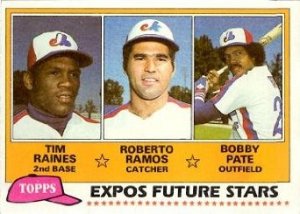
The Raines Topps rookie card is one of the top rookies from the 1981 series. Issued just before the mass-produced sets of the ‘80s, the Expos “Future Prospect” card also includes Roberto Ramos and Bobby Pate, two “future stars” that never panned out. Be careful if you’re buying: The “Future Prospect” cards are notorious for having gum-stained backs.

Book Review: Ty Cobb: A Terrible Beauty

Whether you fancy yourself a baseball historian or a baseball fan with at least a remote interest in the game’s glorious history, Charles Leerhsen’s Ty Cobb: A Terrible Beauty is an absolute must read.

Leerhsen’s wide-ranging reporting and storytelling skills are on full display as he debunks the myths and sheds light on the complicated but brilliant career of Ty Cobb. Most of what we knew about Cobb was written in 1961 by biographer Al Stump, a man who seemed to have a personal grudge against the highly toxic Cobb. Looking for a quick profit and instant fame, Stump did not allow the truth to interfere with a sensational story. Many of Cobb’s digressions — and there were many — were greatly exaggerated to make for a better read.

Leerhsen looked deeper into the myths and embellished stories surrounding Cobb. His account of the Georgia Peach is based on information derived from tireless research and interviews. What he found was a flawed, complicated man with unfathomable determination who happened to be one of the greatest baseball players to ever live.

What Leerhsen does best is put Cobb’s life story in perspective with baseball and American life during the rough and tumble times of the early 1900s. Cobb was a smart, young upstart athlete from the south, a fierce competitor who rubbed many the wrong way. He found rookie hazing unacceptable, which did not sit well with veteran teammates. His aggressive, hard-nosed approach to the game threatened teammates who feared losing their jobs and opponents who were being tested in new ways.

During a time when disputes were often settled with fists both on and off the playing field, Cobb had his share of fisticuffs with teammates, opponents, umpires, groundskeepers, hotel staff and even fans — or “cranks” as they were called back in the day. Leerhsen explains how some of these stories were true, others greatly exaggerated, and some completely false. He sheds light on how Cobb struggled with being the first celebrity athlete; the most famous athlete beyond his hometown; the athlete the President wanted to meet.

We may never know all the facts surrounding Cobb’s life, but Leerhsen’s meticulously researched account gives baseball fans much to think about regarding the first player elected to the Hall of Fame and how he helped to shape baseball’s “Deadball Era.”