David Ortiz and The Most Memorable “Big Papi” Baseball Cards

Since joining the Red Sox 13 years ago, David Ortiz has become the face of the franchise, leading the team to three World Series championships while becoming just the 27th member of baseball’s exclusive 500 home run club. In his final season, Ortiz has become increasingly popular among baseball card collectors. A wide-range of Ortiz variation, rookie, game-used-memorabilia, and autographed baseball cards have been heating up the hobby since the start of the 2016 season.

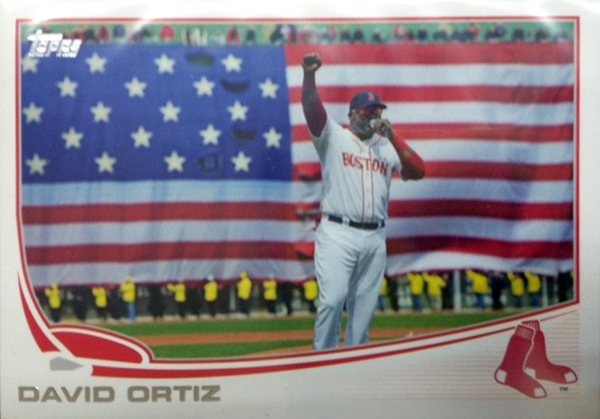
Some of the most memorable and coveted baseball cards are the ones that capture a unique moment in baseball or a city’s history. The rare variation of Ortiz’s 2013 second series Topps card captures one of the more emotional moments in Boston sports history. A defiant Ortiz took the field just five days after the tragic Boston Marathon bombing, making an impassioned, heartfelt speech declaring the city’s resolve.

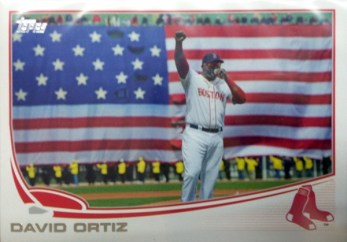
Known in collectible circles as the “Boston Strong” card, Ortiz is pictured with a microphone in one hand and a clenched fist raised to the heavens with the other. In the background is a giant American flag draped over Fenway’s left field wall, creating a uniquely patriotic scene. Upon release, the short-printed “Boston Strong” card sold in the $50-$75 range. Following the Red Sox third World Series title in 10 years in October of the 2013 season, the card was selling in excess of $150. With the Big Papi Farewell Tour in full swing, the card is currently selling for as much as $199.

Ortiz played a huge role in the Red Sox six-game 2013 World Series victory over the St. Louis Cardinals, hitting .688 with two homers and six RBI en route to being named World Series MVP. The popular Topps World Champion autograph insert set features top postseason sluggers. The 2014 edition captures Ortiz’s famed home run stroke along with his certified signature. Limited to a production run of 50, the Ortiz World Series autographed card sells for $59.

When Ortiz joined the Red Sox in 2003, there was considerable confusion surrounding his rookie baseball cards. Prior to signing with the Red Sox, Ortiz played several seasons in the Seattle and Minnesota systems. Signed out of the Dominican Republic by the Mariners in 1994 just days after his 17th birthday, Ortiz, who gradually established himself as a power-hitting prospect, was traded to the Twins as the player to be named later for Dave Hollins prior to the 1997 season.

After joining the Twins system, Ortiz decided to change his baseball name. His legal name had always been David Americo Ortiz Arias. While playing with the Mariners, he went by his maternal family name (Arias) rather than his paternal family name (Ortiz). As a result, his earliest baseball cards are listed as David Arias. With the Twins, he requested to be called Ortiz, which has stuck ever since.

Ortiz joined the Red Sox as a platoon player in 2003, so many collectors didn’t connect the dots between David Arias and David Ortiz, meaning the Arias rookie cards were readily available for under $1 during the first half of the season. With more playing time came more home runs and a knack for late-inning heroics. By season’s end Ortiz slugged 30 homers in just 128 games, boasting the David Arias cards to $10-$15.

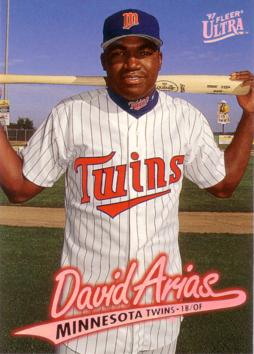
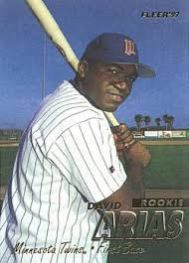
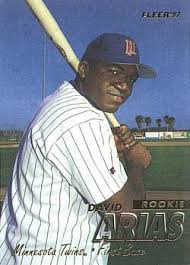
One of only two OrtBostonStrongiz rookie cards, the 1997 Fleer “David Arias” card could be found in 1997 Fleer Series 2 packs. The base version of the card, sporting a throwback matte finish during an era of high-gloss cards, currently sells for $30. The far more limited “Tiffany” parallel version — one of the more valuable Oriz cards in the market — features a high-gloss look and feel while selling for $400 .
The other Ortiz (Arias) rookie is from the 1997 Fleer Ultra series, a slightly more upscale version of the Fleer set, sells for $35. The full-bleed, glossy look was a popular alternative to the high-priced Tiffany parallel set. Gold Medallion parallel versions display a different picture and gold-foil lettering. Limited to just 200 copies, the popular parallel version sells for $49.

The Topps Bowman brand, known as the “Home of the Rookie Card”, somehow bypassed Ortiz in its 1997 set. Sometimes wrongly advertised as a rookie, the 1998 Bowman Ortiz is readily available for under $4. Far more limited chrome and International refractor parallel versions sell for $18 and $15 respectively.

For oddball baseball card collectors, there is a handful of Ortiz minor league pre-rookie cards that have become quite popular in the slugger’s final season. The Ortiz (Arias) 1996 Wisconsin Timber Rattlers Midwest League All-Star card,is an overlooked gem selling for $48. His 1998 New Britain Red Cats Best minor league card is selling for $15. Both cards feature a relatively elementary design with simple white borders — a far cry from the the glitzy, full-bleed photos popular with major league sets in the late ‘90s. The more mainstream Upper Deck 1998 SP minor league Ortiz card — featuring a portrait of a svelte, smiling Ortiz inside a silver foil border — sells for $5.

Ortiz made his Topps debut in the 1998 edition where he was featured in a prospect card with future All-Star slugger Richie Sexson. Ortiz made his first appearance in a Red Sox jersey in the more obscure 2003 Fleer Update Series and the 2003 Upper Deck 40-Man set. All three cards can be had for $3.

The hobby’s most sought after and costly cards are serial numbered autographs of baseball’s top players. Ortiz autographs have been extremely active in the secondary market since the start of the season. His 1997 Donruss Signature Series Autograph is his first card to carry the name “David Ortiz” instead of “David Arias”. The base version (red background) has 3,900 copies and is selling for $122, while the Millennium parallel Version (green background) is limited to 1,000 copies and is selling for $225. Perhaps the most valuable Ortiz autographed card is the Signature Series Century Autograph (blue background) is numbered to just 100 and is selling for $600.

A common gripe among autograph collectors is Ortiz’s failure to sign within the designated area of the Donruss Signature Series. Most signatures in all three versions appear towards the side of the card rather than the bottom. Ortiz’s signing gaffe may have held down the card values before he established himself as one of the game’s top sluggers. There is no such issue today.The 2005 SkyBox Autographics signature card is available for under $60, providing a nice alternative to the high priced Signature Series autographs.

As Ortiz approaches his final playoff run, expect his baseball cards to sell at elevated prices. A deep Red Sox playoff run will mean increased attention for their charismatic slugger, which means inflated values for his cards. You can anticipate card values to decline and level off shortly after the 2016 season. The next boost for Ortiz cards will come in five years when one of the Red Sox all-time sluggers is Hall of Fame eligible.

The Hall of Fame electorate and many old school baseball fans have shunned the DH position since its inception in 1973. Edgar Martinez, one of the best pure hitters of his time, has yet to receive more than 36.5 percent of the HOF vote in six tries. Quality hitters such as Don Baylor and Harold Baines have barely registered a blip on the HOF ballot.

However, the anti-DH faction has been weakening in recent years. Enshrined in 2004, Paul Molitor served as his team’s DH for nearly half of the games he started. Last year, Frank Thomas became the first HOFer to DH in the majority of his games played.

Ortiz is looking to become the first full-time DH to receive baseball’s highest honor. He has established the standard for designated hitters, collecting more hits, home runs, and RBI than any other DH. His endless late-inning production — including 11 walk-off homers — have made Ortiz one of baseball’s most feared hitters throughout his Red Sox career.

Ortiz’s Mantle-esque playoff production (a slash line of .295/.409/.553 with 17 homers and 60 RBI) have made him one of the game’s most recognized players. His postseason success and affable persona has made Big Papi the ultimate fan favorite among Red Sox fans, which reflected by his many memorabilia cards. His 2013 Topps Tier One Game Used Jersey and 2014 Panini Classics Game Used bat cards, each selling for $15, are great additions to any Red Sox baseball card collections.
David Oritz Makes Us Remember Legendary Slugger Jimmie Foxx

As David Ortiz climbs the charts among baseball’s all-time great sluggers, we see the name Jimmie Foxx appear in the record books over and over again, but for some reason Ole Double-X is seldom discussed. Dubbed “The Beast” because of his powerful right-handed swings, Foxx was one of the most underappreciated players in baseball and sports collectibles history.

Hall of Fame pitcher Lefty Gomez once proclaimed, “When Neil Armstrong first set foot on the moon, he and his space scientists were puzzled by an unidentifiable white object. I immediately knew what it was. That was the home run ball hit off me in 1937 by Jimmie Foxx.”

Foxx equaled or surpassed the production of nearly every slugger not named Babe Ruth, but he his rarely mentioned among baseball immortals such as Lou Gehrig, Ted Williams, Hank Aaron, Mickey Mantle et al — and the demand for his baseball cards lag considerably behind baseball’s most revered sluggers.

Foxx hit at least 30 home runs and tallied 100 or more RBI from 1929 with the Philadelphia Athletics to 1940, his fifth season with the Red Sox. His 20-year total of 534 home runs ranked second to Ruth for many years. His 58 home runs in 1932 fell just two short of Ruth’s single-season record. Interestingly, two home runs were taken away from Foxx because of rain and 10 more were lost because of newly constructed outfield screens in Cleveland, St. Louis, and Philadelphia that were not erected until after Ruth hit 60. So if the baseball stars were properly aligned in 1932, Barry Bonds would have eclipsed the magical number of 70 set by Foxx.

While serving as the Red Sox first baseman, Foxx quickly learned to take advantage of the cozy confines in front of Fenway Park’s famed Green Monster. In his first three seasons with the Red Sox, he hit 41, 36, and 50 homers respectively.

Yankee Hall of Fame catcher Bill Dickey said of Foxx’s ridiculous power, “If I were catching blindfolded, I would always know it was Foxx who connected. He hit the ball harder than anyone else.”

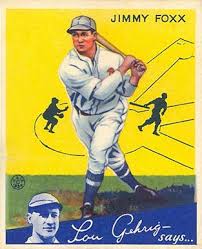
The toughest Foxx baseball card to find in reasonable condition is the 1934 Goudey (#1). First cards of vintage sets received the brunt of the rubber band damage that decimated so many ’50s and ’60s baseball cards. A handful of PSA-8 versions exist, selling for $8,200, a remarkable buy considering ’34 Goudey PSA-8 Gehrig cards command as much as $15,000.

Foxx, provided Boston with their first bona-fide star since Ruth was sold to the Yankees in 1919. Double XX set Red Sox records for home runs (50) and RBI (175) during his 1938 MVP season. More than just a slugger, Foxx won the Triple Crown in 1933 and excelled defensively, primarily as a first baseman, but also as a catcher, third baseman, and outfielder.

Foxx was inducted into the Baseball Hall of Fame in 1951, but strangely there has been little or no protest over the Red Sox failure to retire his number. Surely someone who is mentioned in the same breathe as Ruth and Gehrig deserves the same elite status as Joe Cronin, Bobby Doerr, Ted Williams, Carl Yastrzemski, Johnny Pesky, Carlton Fisk and Wade Boggs in Red Sox annals.

Playing his only season with the Red Sox in 2006, infielder Mark Loretta told the Boston Herald that “Foxx never received the credit he deserved for being one of the game’s all-time great sluggers.” Loretta honored Foxx by wearing number 3. Foxx, who played 20 seasons for the Philadelphia Athletics (1925-35), Red Sox (1936-42), Chicago Cubs (1942 and 1944) and Philadelphia Phillies (1945), is arguably the best slugger not to have his uniform retired by any team.

Modern day cards of Foxx are somewhat limited, but affordable. His 2005 Upper Deck Trilogy Bat displays a vintage photo of Foxx in his Philadelphia Athletics uniform with a piece of an actual Foxx baseball bat embedded into the card can be had for under $45 — a great buy for limited card serial numbered to just 99.

Happy Birthday Carl Yastrzemski

Happy birthday to Red Sox great Carl Yastrzemski, who turns 77 today. A leader in virtually every major offensive category in Red Sox history, the man they call Yaz is still one of the franchise’s most popular players.

Revered for playing the lead role in the “1967 Impossible Dream” season, Yaz became baseball’s 14th Triple Crown winner, while leading the Red Sox to the American League Pennant. Powering the Red Sox from last place in 1966, Yaz hit .326 for his second batting title, tied Harmon Killebrew with 44 homers and drove in 121 runs. Yaz capped the season off with 10 hits in 13 at bats.

Upper Deck commemorated the historic feat with the 2007 UD Premier Stitchings “Triple Crown Commemorative Patch”. The card back salutes Yastrzemski’s three AL batting titles, six gold gloves, 18 All-Star Games and his 1989 Hall of Fame enshrinement. Limited to a production run of 50, this popular Yaz item is a great buy for $20.

In one of the greatest seasons ever for a Red Sox player, Yaz led the team to the World Series and bolstered his Triple Crown numbers by pacing the AL in runs, hits and total bases. Over his 23-year-career, Yaz collected 3,419 his, 1,844 RBI, 452 homers — at a time when 400 homers was an accurate benchmark for a top slugger — and seven gold gloves. The 18-time All-Star was inducted into the Baseball Hall of Fame in 1989 on the first ballot.

Yastrzemski’s 1960 Topps rookie card, part of the Sport Magazine “Rookie Star Subset”, sells in the $160- $180 range. Print marks on some copies — a problem throughout the 1960 Topps series — limits the number of truly mint Yaz rookies. The only other major rookie card of the set belongs to Willie McCovey. Finding a well-centered Yaz or McCovey rookie is a daunting task. The popular 1967 Yaz card is a great buy for $18 in excellent condition.

With each passing season the legend of Yastrzemski’s accomplishment grows. Only 15 players have had Triple Crown seasons — Miguel Cabrera joined the select group in 2012 — with Rogers Hornsby and Ted Williams each achieving it twice. Former Red Sox Slugger Jimmie Foxx slugged for the Triple Crown in 1933 while playing for the Philadelphia Athletics.  Baseball immortals such as Hank Aaron and Willie Mays didn’t do it. Babe Ruth came close in 1924, leading the AL in batting and homes, but losing the RBI title to Goose Goslin.

Alex Rodriguez and Barry Bonds have led their respective leagues in all three categories, but never in the same season. In 2006 David Ortiz was first in the AL in homers and RBI, but hit just .287. With more and more batters specializing in either hitting for batting average or power, a Triple Crown winner in the near future is becoming less and less likely.

Happy Birthday To The Great Satchel Paige

Baseball legend Satchel Paige was born on this day in 1906. Forty-five years ago this month, Baseball Commissioner Bowie Kuhn announced that former Negro League players will have a separate wing in the Hall of Fame. Not surprisingly, Kuhn’s separate, but equal Hall of Fame policy did not set well with the American public, particularly baseball players from the pre-segregation era.

Paige and Ted Williams were among the most vocal former players. Paige was famously quoted: “I was just as good as the white boys. I ain’t going in the back door of the Hall of Fame.”

Williams, in his 1966 HOF acceptance speech, urged Major League Baseball and the Hall to open the doors to Negro League stars, referencing Paige, Willie Mays and Josh Gibson among others.

On July 6, 1971 — five months after Kuhn’s backward-thinking-policy was announced — MLB and the HOF succumbed to public pressure and opened the doors to Paige with full HOF membership, which cleared the way other Negro League stars in the years to follow.

Paige’s 2004 Leaf Certified Materials Game Used Jersey cards are some of the most overlooked memorabilia cards ever produced.  He spent 22 seasons dominating the Negro Leagues and six years in the majors before being enshrined in the Hall of Fame in 1971. There were several versions of Paige’s first memorabilia cards issued in Leaf Certified’s “Mirror Materials” parallel set and the tiered “Fabric of the Game” insert set — all limited to a production run of 100 and selling for over $100.

Paige threw a remarkable 55 no-hitters during his Negro League career, becoming the league’s most popular and recognizable player, not to mention its largest gate attraction. He joined the major leagues in 1948, helping the Cleveland Indians win the World Series as a “rookie.”

In 1965, at the age of 59, nearly 12 years since he last pitched in the majors, Paige pitched one game for the Kansas City A’s, pitching three shutout innings. Three years later, he was a coach for the Atlanta Braves, where he wore the jersey Donruss officials used to incorporate into 2004 Leaf Certified Materials.

Known for longevity and age as a major leaguer, Paige was a Negro League legend in his younger days. At a time when African-Americans were barred from the majors, Paige drew huge crowds of black and white baseball fans. He led the Pittsburgh Crawfords to top billing in the Negro Leagues as a fireballer in the early ’30s and did the same for the Kansas City Monarchs in the early ’40s as finesse pitcher.

Barred from the majors, Paige was often tempted to jump from team to team to earn a decent wage. In 1937, he joined a large group of Negro Leaguers traveling to the Dominican Republic to play for a team owned by Dominican president Rafael L. Trujillo. The following season, Paige hurt his arm pitching in the Mexican League, but quickly transformed from a “thrower“ to a “pitcher.” He returned to the states using guile and control in leading the Monarchs to four consecutive pennants before entering the majors.

The first of just a few Paige baseball cards was issued by Topps in 1953 (#220). A headshot captured the 47-year-old reliever in his St. Louis Browns uniform. Unfortunately, the Topps spelling of “Satchell” was incorrect and never corrected. The card was issued following a 12-10 season with a 3.07 ERA. Paige’s ’53 Topps card is selling for $350 online in decent condition.

The Mystery Surrounding David Ortiz (Arias) Rookie Baseball Cards

When David Ortiz joined the Red Sox in 2003, there was considerable confusion surrounding his rookie baseball cards. Prior to signing with the Red Sox, Ortiz played several seasons in the Seattle and Minnesota systems. Signed out of the Dominican Republic by the Mariners in 1994 just days after his 17th birthday, Ortiz, who gradually established himself as a power-hitting prospect, was traded to the Twins as the player to be named later for Dave Hollins prior to the 1997 season.

AriasUltra
David “Arias” Ortiz 1997 old-style, matte-finish Fleer Rookie.

After joining the Twins system, Ortiz decided to change his baseball name. His legal name had always been David Americo Ortiz Arias. While playing with the Mariners, he went by his maternal family name (Arias) rather than his paternal family name (Ortiz). As a result, his earliest baseball cards are listed as David Arias. With the Twins, he requested to be called Ortiz, which has stuck ever since.

Ortiz joined the Red Sox as a platoon player in 2003, so many collectors didn’t connect the dots between David Arias and David Ortiz, meaning the Arias rookie cards were readily available for under $1 during the first half of the season. With more playing time came more home runs and a knack for late-inning heroics. By season’s end Ortiz slugged 30 homers in just 128 games, boasting the David Arias cards to $10-$15.

One of only two Ortiz rookie cards, the 1997 Fleer “David Arias” card could be found in 1997 Fleer Series 2 packs. The base version of the card, sporting a throwback matte finish during an era of high-gloss cards, currently sells for $30. The far more limited “Tiffany” parallel version — one of the more valuable Oriz cards in the market — features a high-gloss look and feel while selling for $400 .

The other Ortiz (Arias) rookie is from the 1997 Fleer Ultra series, a slightly more upscale version of the Fleer set, sells for $35. The full-bleed, glossy look was a popular alternative to the high-priced Tiffany parallel set. Gold Medallion parallel versions display a different picture and gold-foil lettering. Limited to just 200 copies, the popular parallel version sells for $49.

The Topps Bowman brand, known as the “Home of the Rookie Card”, somehow bypassed Ortiz in its 1997 set. Sometimes wrongly advertised as a rookie, the 1998 Bowman Ortiz is readily available for under $4. Far more limited chrome and International refractor parallel versions sell for $18 and $15 respectively.

For oddball baseball card collectors, there is a handful of Ortiz minor league pre-rookie cards that have become quite popular in the slugger’s final season. The Ortiz (Arias) 1996 Wisconsin Timber Rattlers Midwest League All-Star card, is an overlooked gem selling for $48. His 1998 New Britain Red Cats Best minor league card is selling for $15. Both cards feature a relatively elementary design with simple white borders — a far cry from the the glitzy, full-bleed photos popular with major league sets in the late ‘90s. The more mainstream Upper Deck 1998 SP minor league Ortiz card — featuring a portrait of a svelte, smiling Ortiz inside a silver foil border — sells for $5.

Ortiz made his Topps debut in the 1998 edition where he was featured in a prospect card with future All-Star slugger Richie Sexson. Ortiz made his first appearance in a Red Sox jersey in the more obscure 2003 Fleer Update Series and the 2003 Upper Deck 40-Man set. All three cards can be had for $3.

All-Star Shortstop Xander Bogaerts Heats Hobby

Xander Bogaerts entered the 2016 season as an emerging star. Three months into the season, he’s become baseball’s finest shortstop, arguably the game’s top hitter, and a viable American League MVP candidate. Being compared to big-time stars such as Mike Trout, Manny Machado, and Bryce Harper, Bogaerts has become a top star in the collectibles world as well.

The diversity of Bogaerts’ skills have been on full display since the start of the season. Spraying the ball to all fields, while also finding the gaps, Bogaerts has exploited defensive shifts by hitting to the open areas. The result has been a higher batting average and increased production — more hits with runners on base while anchoring a potent Red Sox offense from the third spot in the lineup. Wade Boggs’ Red Sox single-season hit record (240) is well within his sights.

Taking baseball and the hobby by surprise, Bogaerts game-used memorabilia and certified autographed cards are few and far between for the time being. His limited 2015 Topps Gypsy Queen Red Framed Jersey card is a hot item selling for $12, while his popular 2015 Topps Career Highlights Game Used Jersey card sells for as much as $10. A 26-game hitting streak earlier in the season put Bogaerts in the national spotlight, increasing the the interest and value of his memorabilia cards.

Bogaerts has led the league in hits and batting for most of the season, while also placing among the league best in runs, RBI, doubles, and OPS. Most defensive metrics rank him among baseball’s best fielding shortstops. He also excels on the basepaths, stealing bases at opportune times while taking extra bases with regularity.

With an All-Star appearance in the offing, Bogaerts will be a focal point of many mid- and late-season baseball card releases. Expect to see a wide assortment of new Bogaerts game used and autographed cards in the coming months. For now, his 2012 Rize Prodigy Gold Autographed insert limited to a pr
oduction run of 100 is selling for $40

Just 23 years old, Bogaerts has become the best all-around shortstop to wear a Red Sox uniform since Nomar Garciaparra’s prime years of 1998-2000. Like Garciaparra rookie cards in the late ‘90s, Bogaerts’ earliest cards have become “must haves” for Red Sox collectors. His 2012 Bowman Chrome Rookie — a mere common card less than a year ago — is selling for $5. Limited autographed Bowman Chrome rookies are selling for $124, with “Blue Refractor” autographed versions limited to a production run of 50 approaching $1,000.

Impressed by his athletic ability and live bat, the Red Sox signed Bogaerts at the age of 17 out of his native Aruba for $410,000. As a teenager, Bogaerts represented the Netherlands in the 2013 World Baseball Classic, opening eyes with his play on the field and his maturity off the field. Bumped to third base to accommodate slick-fielding fellow countryman Andrelton Simmons, Bogaerts looked like a seasoned veteran, hitting .263 with a .364 on base percentage.

Off the field he impressed with advanced people skills and speaking fluently to reporters in four different languages (English, Spanish, Dutch and Papiamento). One of his rarest baseball cards is the 2013 Topps Tribute World Baseball Classic Game Worn Jersey, which is limited to a production run of 67 and is becoming increasingly popular, selling for $80. The Bogaerts base card from the WBC set can be had for $3.

With his baseball IQ on par with his on-the-field proficiency, Bogaerts looks to be a pillar in the Red Sox lineup for many years to come. An increasing international following will heighten the demand and value of his cards, so buy early and often. With David Ortiz in the twilight of his career, Bogaerts is quickly becoming the face of the Red Sox.

Derek Jeter and His Baseball Cards

Future Hall of Famer Derek Jeter turns 42 years old today.

A modern-day baseball card collection is not complete without a wide assortment of Derek Jeter rookie and insert cards. As the Yankee captain’s brilliant 20-year career comes to an end, his 23 years in the hobby are being widely celebrated.

One of the more highly touted players in baseball history, Jeter is featured on more than 325 different baseball cards issued from the year he was drafted (1992) to the year he earned AL Rookie of the Year honors and lead the Yankees to their first World Series Championship in nearly two decades (1996). Jeter’s four-year development in the Yankees farm system overlaps the the hobby’s growth of insert cards — limited edition cards randomly inserted into packs. Many of these cards are short-printed, parallel variations of the base card.

Most price guides and memorabilia dealers consider 23 or so of the Jeter cards issued in 1993 as rookies. Most leading manufacturers of the time — including Topps and its Bowman brand, Score and it’s Pinnacle brand and Upper Deck with it’s high-end SP brand — featured highly-coveted cards of the future Yankees great. You can also find an additional 17 or so minor league or pre-rookie Jeter cards released in 1992, including various cards from the Classic 4-Sport Collection and Front Row picturing the future Hall of Famer in his high school uniform.

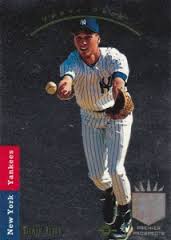
Jeter’s 1993 Upper Deck “Top Prospect” rookie card features the Gulf Coast League Yankees 18-year-old shortstop tracking down a fly ball in the sun. The bland, somewhat blurry full-bleed photo displays the low-budget printing technology manufacturers used on base brands at the time. The card back highlights Jeter’s career at Kalamazoo Central High School (New Jersey), including a .557 batting average and seven home runs during his junior year. The Upper Deck rookie is good buy for under $10

Upper Deck’s 1993 SP Jeter rookie features the high-gloss foil technology reserved baseball’s high-end card sets. The ‘93 SP series is one of the most condition-sensitive sets ever released. Chipping around the foil corners is fairly common. Finding a sample free of smudges, fingerprints or scuff marks on the foil front is almost impossible. Twenty-one years ago, Jeter SP rookies went from packs to hobby store shelves carrying a $25 price tag. Today, a sample in decent condition goes for $85, while rare BGS-9 Mint versions sell for as much as $700. Buyback autograph versions issued in the 2009 SP Authentic series sell for more than $1,400.

The 1993 Topps Jeter rookie will never measure up to the iconic 1952 Topps Mickey Mantle rookie in hobby significance, but it remains one of the most sought-after cards of the ‘90s. The card front sports the lanky future prospect in a navy blue Yankees practice jersey and pinstripe pants against a green-diamond-design backdrop reserved for the “Draft Picks” subset. The card back highlights the 1992 Gatorade and USA High School player of the year who also carried an impressive 3.82 grade point average.

The Topps rookie currently sells for $$8-$10. Printing defects within the green background leave many of these cards in less-than-mint condition. Graded Mint versions are selling for $70. The more limited “Gold” parallel versions displaying gold foil over the nameplate and Topps logo are hot items selling for $22. The Jeter 1992 Topps Gold rookie is not considered rare by today’s standards nor is it highly condition sensitive, but the demand for the card increased during Jeter’s farewell season and will again when he’s Hall of Fame eligible. Highly-graded versions are selling for over $30.

With more post-season records than any player in baseball history, the most career hits for a shortstop, five World Series wins and 12 All-Star appearances on his resume, the face of the Yankees for the past two decades has secured a high standing in the hobby for many years to come.

David Ortiz 2013 Topps Boston Strong Variation

Since joining the Red Sox 13 years ago, David Ortiz has become the face of the franchise, leading the team to three World Series championships while becoming just the 27th member of baseball’s exclusive 500 home run club. On the verge of retirement, Ortiz has become increasingly popular among baseball card collectors. A wide-range of Ortiz variation, rookie, game-used-memorabilia, and autographed baseball cards have been heating up the hobby since the start of the 2016 season, but for the people of Boston there is one card that stands out from the  others.

Some of the most memorable and coveted baseball cards are the ones that capture a unique moment in baseball or a city’s history. The extremely limited variation of Ortiz’s 2013 second series Topps card captures one of the more emotional moments in the Boston sports history.  A defiant Ortiz took the field just five days after the tragic Boston Marathon bombing, making an impassioned, heartfelt speech declaring the city’s resolve.

Known in collectible circles as the “Boston Strong” card, Ortiz is pictured with a microphone in one hand and a clenched fist raised to the heavens with the other in front of giant American flag draped over Fenway’s left field wall, creating a uniquely patriotic background. Upon release, the short-printed “Boston Strong” card sold in the $50-$75 range. Following the Red Sox third World Series title in 10 years later that season, the card was selling in excess of $150. With the Big Papi Farewell Tour in full swing, the card is currently selling for as much as $200.

Ortiz played a huge role in the Red Sox six-game 2013 World Series victory over the St. Louis Cardinals, hitting .688 with two homers and six RBI en route to being named World Series MVP. The popular Topps World Champion autograph insert set features top postseason sluggers. The 2014 edition captures Ortiz’s famed home run stroke along with his certified signature. Limited to a production run of 50, the Ortiz autographed card sells for $59.

Red Sox Retire Wade Boggs’ No. 26

Wade Boggs is getting his due. Sixteen years after retiring from baseball, Boggs will have his number 26 placed on the Fenway Park right field facade, alongside the numbers of eight other Red Sox greats and baseball legend Jackie Robinson. The delay likely had something to do with Wade Boggs jumping ship and winning aWorld Series with the Yankees.

The Hall of Fame third baseman was one of the best hitters to ever wear a Red Sox uniform. His .338 Red Sox batting average is second to only Ted Williams. He won five batting titles and six Silver Slugger awards to go along with seven consecutive seasons with 200 or more hits during his 11 years with the Red Sox. His great eye at the plate combined with high batting averages produced remarkable peak seasons. From 1983-1989, Boggs hit .352 with a .446 on-base percentage, leading the AL in OBP in six of those seven years.

A model of consistency at the plate, Boggs produced a slashline of .328/.415/.413 with 3,010 hits in 18 big league seasons. A poor fielder his rookie season, Boggs worked to become one of the game’s better fielding third basemen, earning two Gold Glove Awards. Boggs also made 12 All-Star Game appearances.

Boggs is a key player in the popular 1983 Topps Baseball Card Set. Considered by many collectors to be the top series of the ‘80s, the ‘83 Topps set includes rookie cards of Boggs, Tony Gwynn and Ryne Sandberg as well as the second-year card of . The dual-photo format — an action or posed photo behind a small circular head shot in the lower righthand corner — has been a fan favorite over the years. Borrowed from the 1963 Topps series, the format allowed Topps to feature a wide-array of action photos without neglecting the traditional head shot.

Midway through the 1982 season, Boggs took over third base from reigning AL batting champion Carney Lansford, who landed on the disabled list with an injured ankle. Lansford never regained his job and was eventually traded to the Oakland A’s. Boggs made him expendable by hitting .349 for the season.

After quickly establishing himself as one of baseball’s premier hitters, Boggs — like Gwynn — was somehow excluded from the 1982 Topps Traded Set. Following a brilliant rookie campaign, Boggs was featured prominently in the 1983 Topps, Fleer and Donruss rookie checklists. Boggs’ elite status continued on the field as the second-year rising star lead the AL with a .361 batting average.

Relative newcomers to the world of baseball card collecting in 1983, Fleer and Donruss played second fiddle to Topps in production, marketing and distribution of their baseball card sets. As a result, Boggs’ rather drab-looking Fleer and Donruss rookie cards were not received with the same fanfare as the first-year Topps issue. Decent versions of the Fleer and Donruss rookies are available for $3-$5.

Because Boggs never hit for much power, except for that one season in 1987 — when many observers suspected baseballs had a little extra “bounce” — his rookie cards may have never reached their full potential. Traditionally, the rookie cards of sluggers are more sought after than the rookies of high-average hitters. Gwynn rookie cards may be slightly undervalued for the same reason. Never known for power, Boggs hit 24 homers in 1987 — when home runs were hit at an unprecedented pace — but never collected more than 11 in any other season.

The 1983 Boggs Topps rookie currently sells for $8 in decent condition with highly-graded versions commanding as much as $50. Because of minor production flaws and gum-stained card backs, the highest-graded versions are extremely rare.

Varitek & Wakefield Inducted Into Red Sox Hall of Fame

Jason Varitek and Tim Wakefield, two of the most popular players in Red Sox history, were rightfully inducted into the Red Sox Hall of Fame last night. The two Red Sox icons announced their retirement and simultaneously tossed out the ceremonial first pitches in the home opener four years ago.

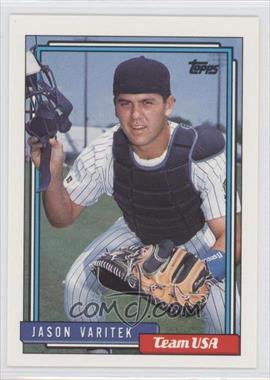
Although Red Sox fans were well aware of Varitek’s significance since his 1998 debut, his rookie baseball card — the 1992 Topps Traded (#123T) — did not receive national acclaim until the Captain’s infamous tussle with Alex Rodriguez that sparked the team’s World Series drive. At the time, this true rookie card sporting the former Georgia Tech star in his Olympic Baseball uniform was selling for $15. Today the same card is a great addition to any Red Sox collection for $5.

On July 31, 1997, the foundation for the the 2004 and 2007 Red Sox World Series teams was put in place. That was the day the Red Sox GM Dan Duquette flee
ced the Seattle Mariners, Heathcliff Slocumb for Varitek and pitching prospect Derek Lowe. Managers, coaches and teammates all confirm that Varitek set the tone for those championship teams.

A catcher with questionable skills in the minor leagues, Varitek became an expert handler of pitchers over his 15-year-career with the Red Sox. He quickly became a fan favorite for his determination and unselfish commitment to winning. As much as anyone, Varitek was responsible for the Red Sox World Series drought ending at 86 years.

So where does Jason Varitek stand in Red Sox history? He caught a major league record four no-hitters, steering Hideo Nomo (2001), Lowe (2002), Clay Buchholz (2007), and Jon Lester (2008) into history. He is the only player in history to have played in the Little League World Series, College World Series, Olympics, Major League World Series and the World Baseball Classic.

The 2007 Upper Deck Goudey “Big League” throwback card (#54) captures one of Varitek’s many unique accomplishments. The card back highlights Varitek becoming the fourth consecutive Red Sox player to hit a home run in an April 2007 game against the Yankees as the Red Sox became just the fifth major league team to smack four straight homers.

The Red Sox Captain has two World Series rings, hit 11 home runs in 63 career postseason games and made three All-Star appearances. His career does not scream Hall of Fame, but he was one of the most significant players to ever wear a Red Sox uniform.

Wakefield also made his mark in Red Sox history. The knuckleballer had 200 career victories, including 186 with the Red Sox, just six shy of the team record shared by Cy Young and Roger Clemens. Wake’s 17 years of service with the Sox is exceeded only by Carl Yastrzemski, Ted Williams and Dwight Evans. He’s featured prominently on the team’s all-time list: first in appearances (590), starts (430) and innings pitched (3,006); second in strikeouts (2,046).

Not bad for a minor league first baseman turned knuckleballer claimed off the scrap heap nearly two decades ago. Wakefield’s limited 1988 Watertown Pirates minor league card is a great buy for $10.